
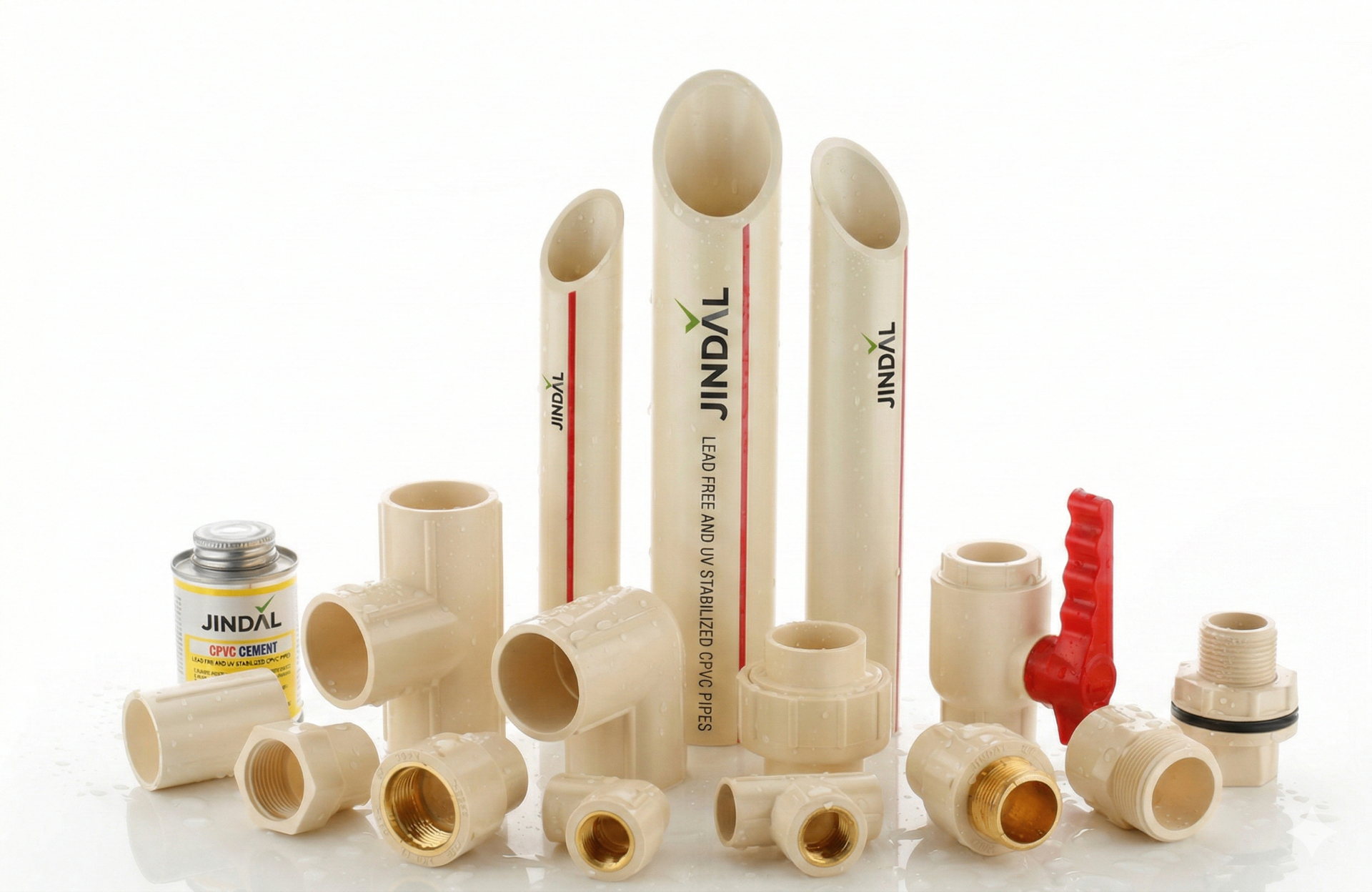
Three pipes, three jobs. PVC drains, UPVC supplies cold water, CPVC carries hot water. Here's the definitive side-by-side so you specify the right pipe in every wall of the building.
Walk into any hardware market in India and you will find at least three white plastic pipes stacked next to each other — PVC, CPVC and UPVC. They look almost identical. They cost different amounts. And picking the wrong one is the number one reason plumbing systems fail within five years of a new building being handed over.
This guide clears up the confusion once and for all. By the end of it you will know exactly which pipe belongs in which part of your project, what the Indian Standards say, and how to avoid the pricing traps that cheap unbranded pipes rely on.
The Three Materials in One Sentence Each
PVC (Polyvinyl Chloride) is the general-purpose rigid plastic pipe used for cold-water supply, agriculture, drainage, casing and conduit.
UPVC (Unplasticised PVC) is a stiffer, plasticiser-free version of PVC engineered specifically for potable cold-water plumbing inside and outside the building.
CPVC (Chlorinated PVC) is PVC that has been chemically chlorinated to survive continuous hot water up to 93 degrees C — it is the pipe that carries geyser output through your walls.
The Comparison Table
The single table below settles most day-to-day specification arguments. Match the row to your application and you have your answer.
| Property | PVC | UPVC | CPVC |
|---|---|---|---|
| Indian Standard | IS 4985 | IS 4985 / IS 16647 | IS 15778 |
| Max continuous temperature | 60 degC | 60 degC | 93 degC |
| Typical pressure class | 2.5 to 10 kgf/cm2 | 6 to 10 kgf/cm2 | SDR 11 / SDR 13.5 |
| Best for | Drainage, agri, conduit, casing | Potable cold water supply | Hot & cold potable water |
| Joining | Solvent cement / ring fit | Solvent cement / ring fit | CPVC solvent cement only |
| Colour convention | Cream / grey | Blue / white | Cream yellow |
| Relative cost per metre | 1.0x | 1.1x to 1.3x | 1.5x to 2.0x |
| Service life | 40 to 50 years | 50+ years | 50+ years |
Where Each Pipe Belongs in an Indian Building
Hot water lines from the geyser to every tap: CPVC. There is no substitute — PVC and UPVC both deform above 60 degC.
Cold water riser from the terrace tank down to each floor: UPVC or CPVC. UPVC is cheaper and perfectly adequate for cold water; CPVC lets you use one pipe type for both hot and cold.
In-wall cold water branch to each fixture: UPVC or CPVC, matching the riser.
Terrace tank inlet, borewell delivery, overhead tank filling: PVC pressure pipes to IS 4985.
Soil, waste and rainwater stacks: PVC SWR to IS 13592 (a separate product family — do not confuse with pressure PVC).
Underground service line from municipal connection to the tank: UPVC or HDPE.
Electrical conduit inside walls and slabs: PVC conduit (IS 9537).
Farm and garden irrigation: PVC agriculture pipes to IS 4985.
The Cost Question
CPVC is the most expensive of the three because chlorination is an extra chemical process. UPVC is a small premium over PVC because of the higher-quality resin and the absence of plasticiser. PVC is the cheapest but is not fit for hot water.
For a typical 2 BHK Indian apartment, the pipe material split usually looks like: 40% CPVC (hot and cold plumbing), 25% UPVC or PVC (terrace and risers), 30% PVC SWR (drainage), 5% PVC conduit. Fighting to save on the CPVC portion is where most rework starts.
How to Verify You Are Buying Genuine Pipe
Every genuine pipe carries an ISI mark and the relevant IS number printed every metre. Check for the manufacturer name, batch code and BIS licence number (CM/L format). Cross-check the licence on the BIS Care mobile app — takes ten seconds and rules out the majority of counterfeits.
Underweight, off-white or foul-smelling pipes almost always fail this check. Reject them at the site gate.
The Jindal Recommendation
For a modern Indian home, our engineers recommend the following mix: Jindal CPVC (IS 15778) for all hot and cold plumbing behind the walls, Jindal UPVC for the terrace-to-floor cold water riser where you want the lowest cost, Jindal PVC SWR (IS 13592) for the drainage stack, and Jindal PVC pressure pipes for the borewell to overhead tank line. Every product carries the ISI mark and is backed by our dealer network across India.
Frequently Asked Questions
What is the main difference between PVC, CPVC and UPVC?
Temperature. PVC and UPVC handle cold water only (up to 60 degC), while CPVC handles continuous hot water up to 93 degC. UPVC is a higher-grade PVC specifically for potable cold water; CPVC is a different material for hot water plumbing.
Can I use UPVC for hot water?
No. UPVC softens above 60 degC and will deform under hot water pressure. Use CPVC for any line above 45 degC.
Which is cheaper, UPVC or CPVC?
UPVC is significantly cheaper — roughly 30 to 50 percent less than CPVC. Use UPVC for cold water and CPVC only where you need hot water resistance.
Do all three follow the same Indian Standard?
No. PVC pressure pipes follow IS 4985, UPVC follows IS 4985 or IS 16647, and CPVC follows IS 15778. Always confirm the correct IS number is printed on the pipe.
Are Jindal PVC, CPVC and UPVC pipes ISI marked?
Yes. Every Jindal PVC, CPVC and UPVC pipe is manufactured under valid BIS licence and carries the ISI mark with the relevant IS number.
Reviewed by
Sahil Jindal
Managing Director, Jindal Composite Tubes Pvt Ltd
3rd-generation pipe manufacturer with 25+ years of hands-on experience in PVC, CPVC and UPVC pipe engineering, ISI/BIS compliance and India-wide plumbing distribution.