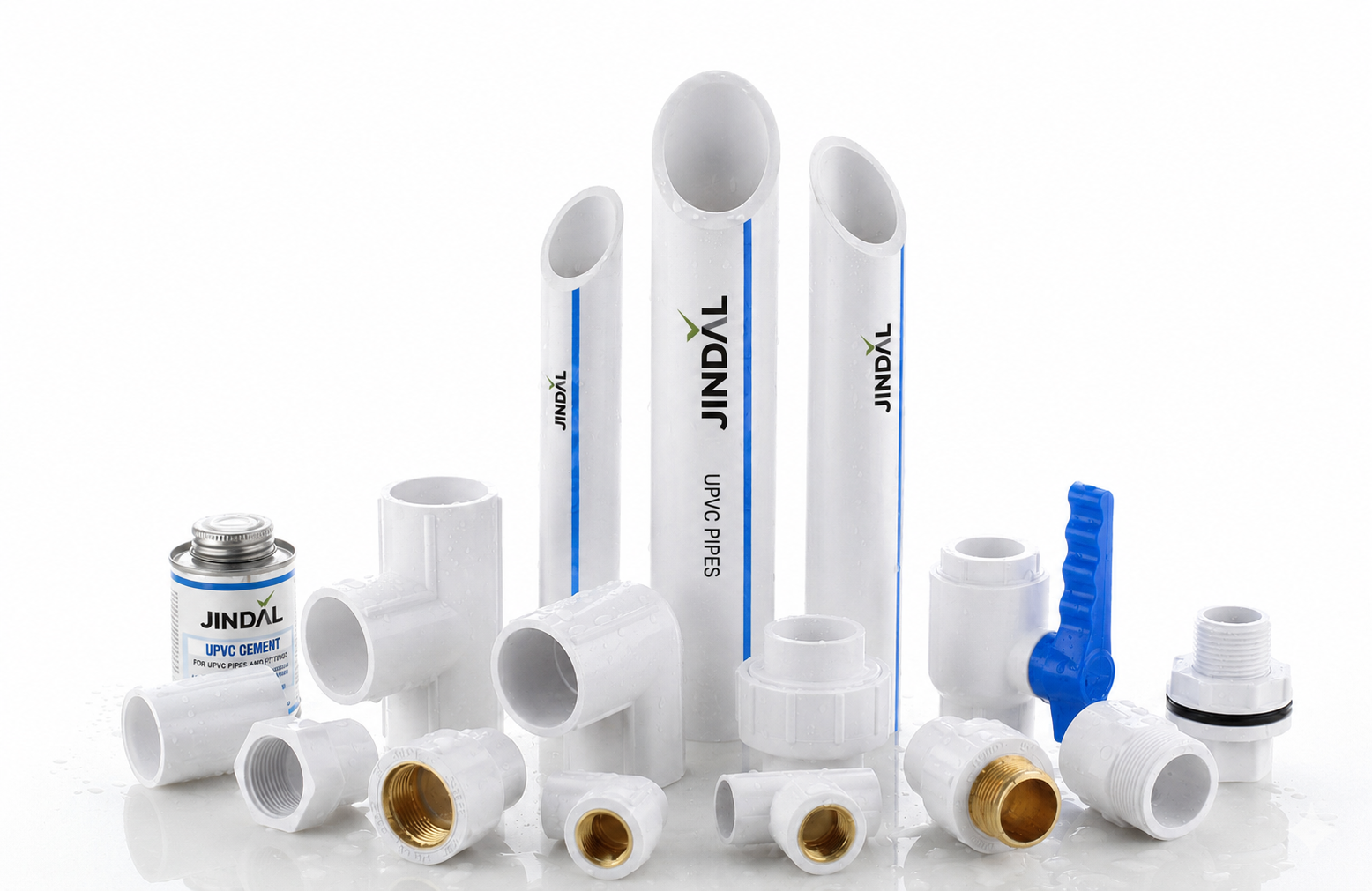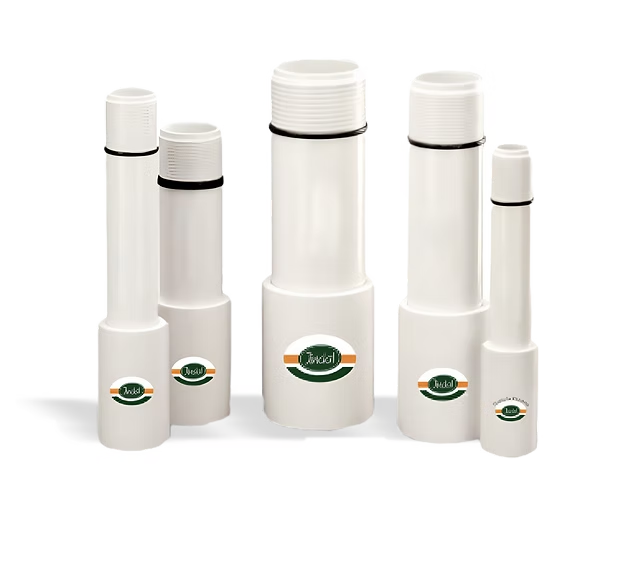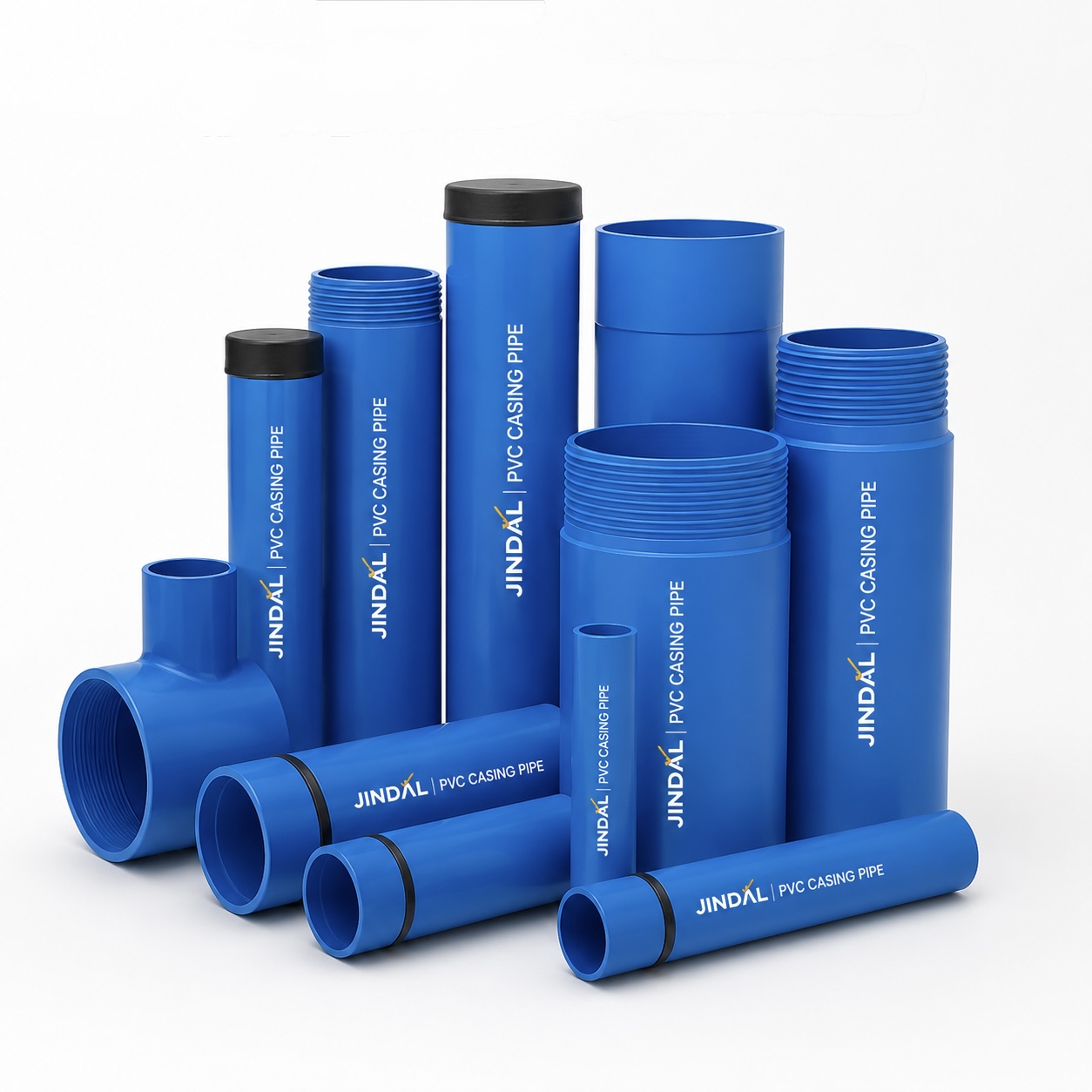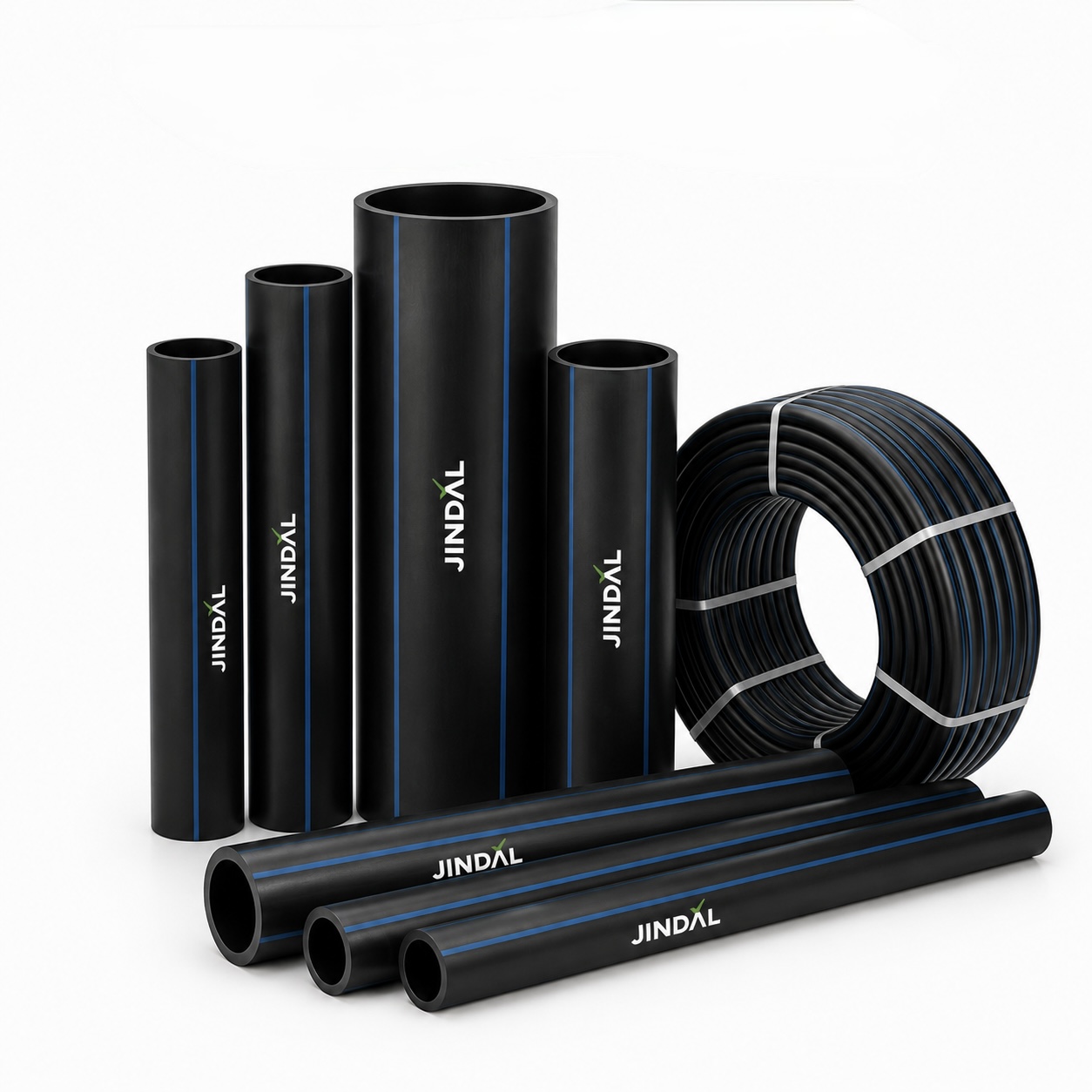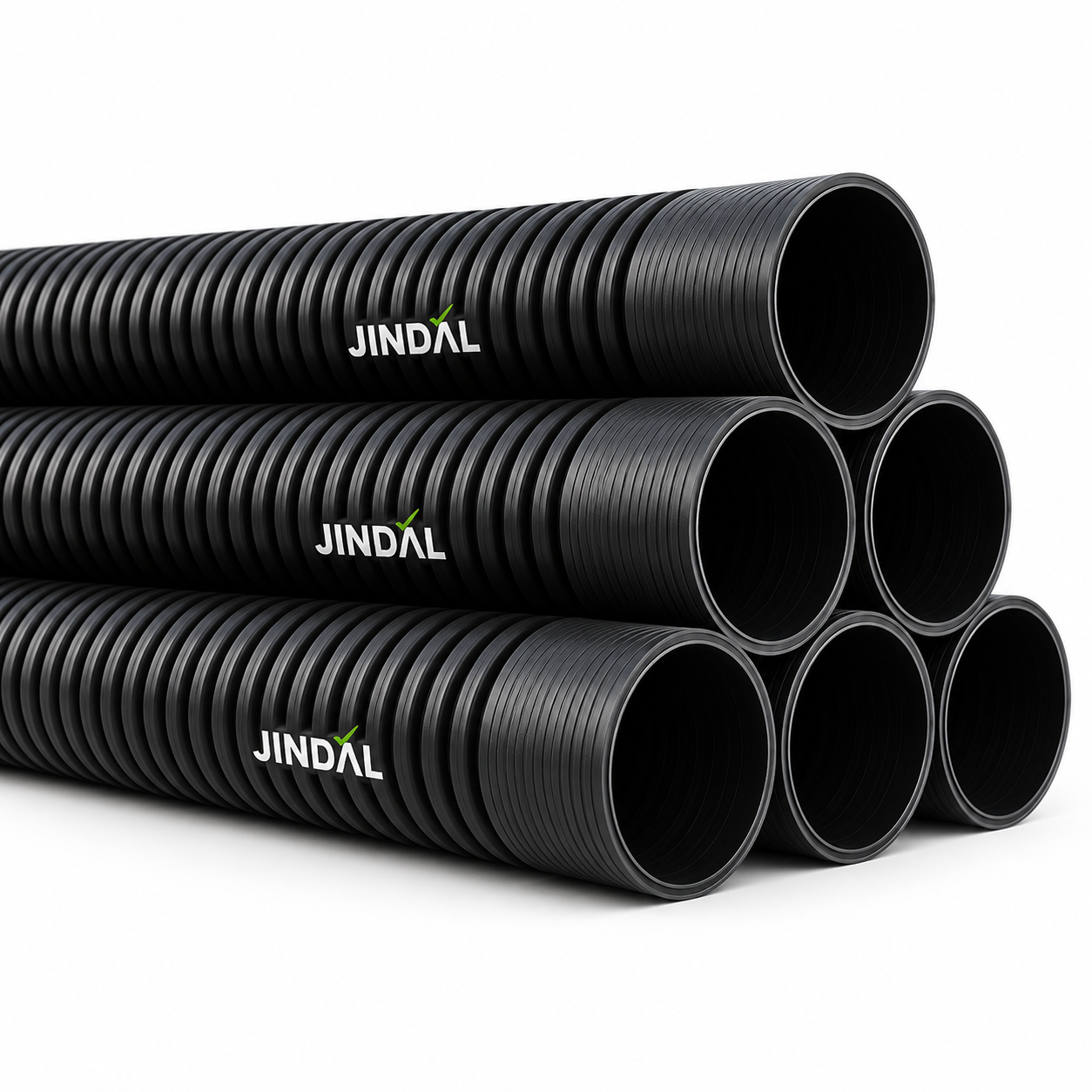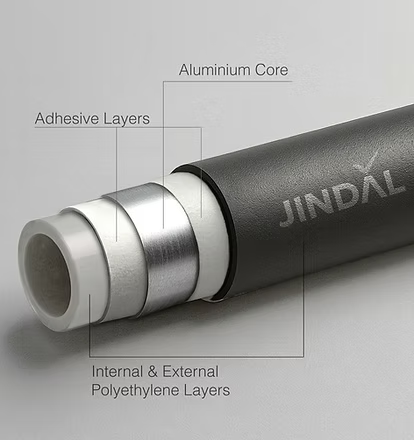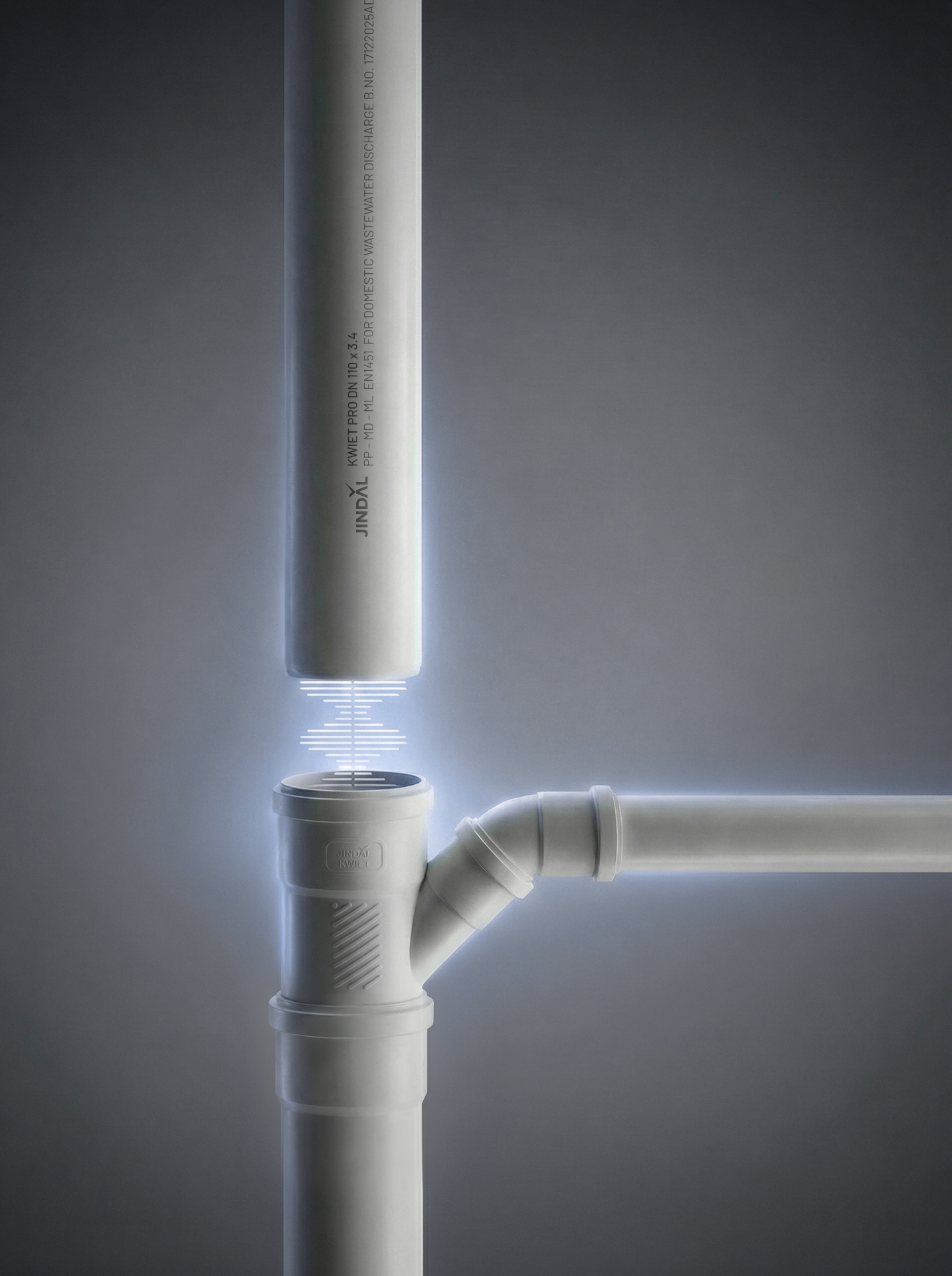
Heat it. Fix it. Forget it.
Polypropylene random copolymer PPR pipes for hot & cold water plumbing — PN 10 to PN 25, fusion-welded, 20–160 mm, rated up to 70°C.
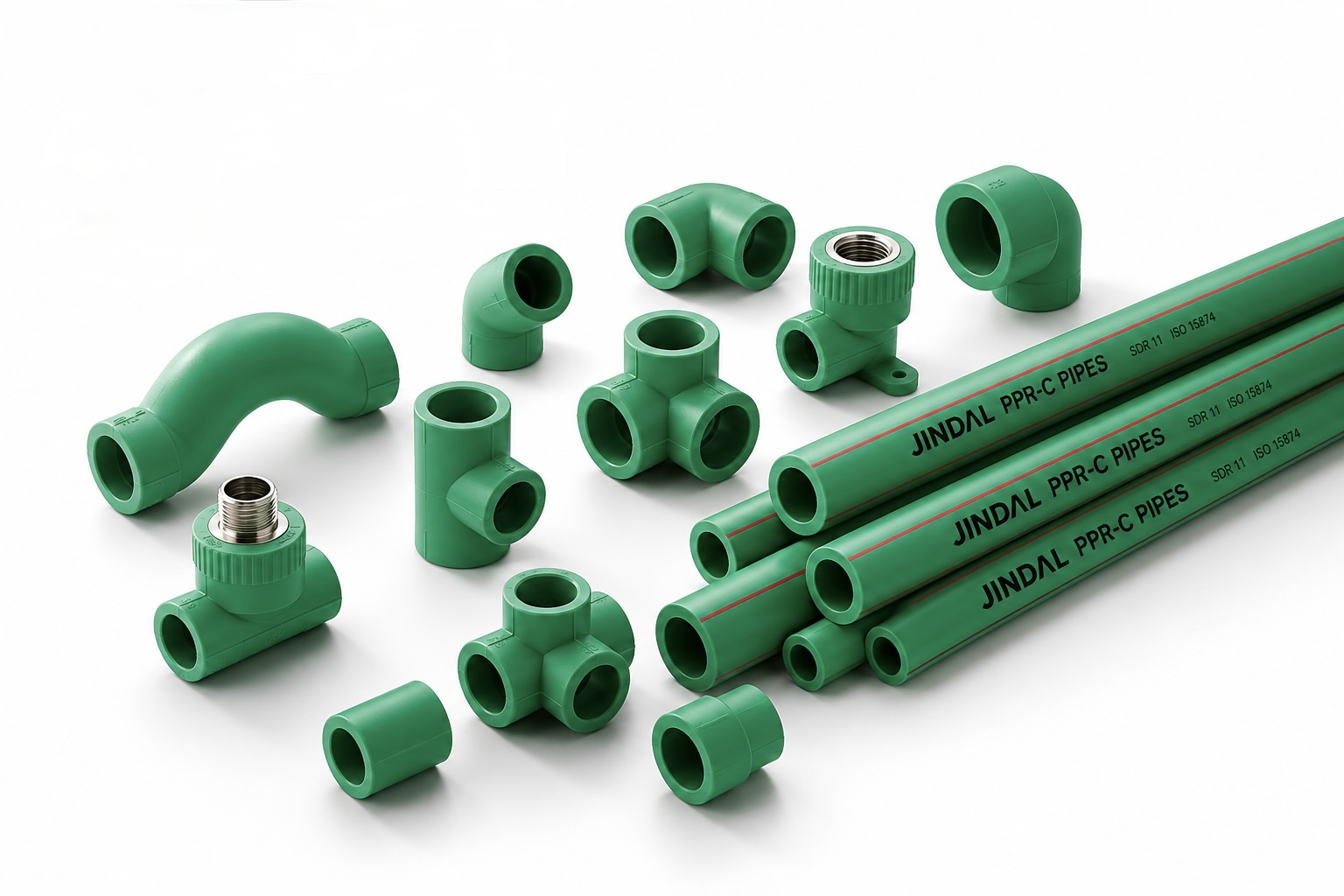
Jindal PPR Pipes and Fittings are made of best quality virgin Polypropylene Random Co-Polymer (PPRC) — a high molecular weight polymer with a stabilization package that prevents thermal degradation during processing and delivers outstanding performance during service.
Engineered for hot, cold and chilled water plumbing, the system offers chemical resistance, leak-proof fusion joints and a service life of 50+ years.
Jindal PPR Pipes are produced as per DIN 8077/8078 in sizes from 20 mm to 160 mm OD (up to 200 mm) in 10, 16 and 20 Kg/cm² pressure ratings, in 3-metre straight lengths or in coil form. Fittings — full range — are produced as per DIN 16962 and readily available in all required sizes in standard packing.
Standard single-layer PPR pipe — ideal for concealed and open plumbing in residential and commercial projects.
Three-layer extruded pipe with UV stabilization for high impact strength and outdoor applications.
All products are manufactured under strict quality control at every stage — mixing of additives, heating, extrusion, cooling, cutting and storage. Tested as per ISO / DIN standards. CIPET test certificates confirm pipes are food-grade and safe for drinking water with no adverse effect on taste or odour.
High impact strength (3-layer pipe, UV stabilized)
Resistant to high temperature — no extra insulation required
Widest operating temperature range: -2 °C to 90 °C
No corrosion — 50+ years service life
Leak-proof joints — zero maintenance, easy repairs
Hassle-free installation, easy adhesion — savings on time & labour
Economical and cost effective
Set the required dies and put the welding machine on heat.
Cut the pipe with a cutter and clean the surface of pipe & fitting.
When the machine indicates readiness, insert the pipe and fitting into their respective dies.
Remove both pipe & fitting after the prescribed heating time — without twisting or turning.
Push the pipe into the fitting immediately, without twisting or turning.
Fitted and fused — ready to use.
| Pipe Dia (mm) | Welding Depth (mm) | Heating Time (s) | Welding Time (s) | Cooling Time (s) |
|---|---|---|---|---|
| 20 | 14 | 5 | 4 | 2 |
| 25 | 15 | 7 | 4 | 2 |
| 32 | 16.5 | 8 | 6 | 4 |
| 40 | 18 | 12 | 6 | 4 |
| 50 | 20 | 18 | 6 | 4 |
| 63 | 24 | 24 | 8 | 6 |
| 75 | 26 | 30 | 8 | 8 |
| 90 | 29 | 40 | 8 | 8 |
| 110 | 32.5 | 50 | 10 | 8 |
| 160 | 41 | 70 | 15 | 12 |
| Property | CPVC | PPR |
|---|---|---|
| Impact Strength | 1.0 – 5.6 | 1.1 – 14.0 |
| Vicat Softening Temp. (°C) | 110 | 130 |
| Max Safe Working Temp. (°C) | 85 | 95 |
| Friction Factor | Low | Very Low |
| Water Absorption (% max) | 0.15 | 0.03 |
| Specific Gravity (g/cm³) | 1.49 – 1.58 | 0.9 |
| Chemical Resistance | Average | Very High |
| Jointing Method | Special Solvent Cement | Simple Heat Fusion |
| Skill Required | Skilled labour | Unskilled labour |
| Line Commissioning | 24 hours | Immediate |
| Service Life | 30 – 40 years | 50+ years |
| Property | PPR | Steel | Galvanized | Copper | UPVC | CPVC |
|---|---|---|---|---|---|---|
| Service Life (years) | 50+ | 3 – 15 | 5 – 25 | 3 – 30 | 0 – 20 | 0 – 50 |
| Brittleness | Resistant | Resistant | Resistant | Worrisome | Not Resistant | Not Resistant |
| Corrosion / Abrasion Resistance | Very Resistant | Very Frail | Very Frail | Very Frail | Partly Resistant | Partly Resistant |
| Ease of Fittings Production | Very Easy | Difficult | Difficult | Difficult | Very Easy | Very Easy |
| Ease of Laying (0 – 100) | 100 | 25 | 25 | 40 | 80 | 80 |
| Hygienic Superiority | Excellent | Worrisome | Worrisome | Worrisome | Worrisome | Good |
| Inner Surface Smoothness | Excellent | Smooth | Smooth | Rough | Rough | Smooth |
| Fitting Range & Cost | Excellent – Cheap | Limited – Expensive | Limited – Expensive | Limited – Expensive | Varied – Cheap | Varied – Expensive |
| Chemical Resistance | Excellent | Problematic | Problematic | Worrisome | Worrisome | Good |
| Joining Reliability (0 – 100) | 100 | 0 – 80 | 0 – 80 | 0 – 50 | 0 – 50 | 0 – 80 |
| Ease of Repair & Maintenance | Very Easy | Troubling | Troubling | Difficult | Difficult | Difficult |
| Pressure Resistance @ PN 20 | >80 bar | >100 bar | >100 bar | >40 bar | 30 bar | 55 bar |
| Property | Test Method | Unit | Value |
|---|---|---|---|
| Density | ASTM D792 | g/cm³ | 0.91 |
| Melt Flow Index (190 °C / 5 Kg) | ASTM D1238 | g/10 min | 0.4 |
| Melt Flow Index (230 °C / 2.16 Kg) | ISO R 1133 | g/10 min | 0.2 |
| Melt Flow Index (230 °C / 5 Kg) | DIN 53 735 | g/10 min | 0.6 |
| Fusion Point | — | °C | 260 |
| Thermal Conductivity (23 °C) | DIN 52612 | W/m·K | 0.23 |
| Specific Heat (23 °C) | — | Kj/kg·K | 1.73 |
| Coefficient of Linear Thermal Expansion | DIN 53 752 | K⁻¹ | 1.5 × 10⁻⁴ |
| Breaking Temperature | ASTM D 746 | °C | -13 |
| VICAT Softening Point | ISO 306 | °C | 130 |
| Shore D Hardness | ISO R 868 | R-scale | 65 |
| Tensile Strength at flow limit (23 °C) | ISO R527 | Kg/cm² | 220 |
| Break Strength (23 °C) | ISO R527 | Kg/cm² | 350 |
| Extension at flow limit (23 °C) | ISO R527 | % | 17 |
| Extension at break (23 °C) | ISO R527 | % | >500 |
| Elasticity Modulus (23 °C) | ASTM D790 | Kg/cm² | 8500 |
| Bend Modulus (23 °C) | DIN 53 447 | N/mm² | 185 |
| IZOD Impact Strength (notched, 23 °C) | ISO R180 | Kg/cm² | No break |
| CHARPY Impact Strength (notched, 23 °C) | ISO R179 | kj/m² | 15 |
Allowable working pressure vs operating temperature.
| Temp (°C) | Pressure (MPa) | Pressure (Kg/cm²) |
|---|---|---|
| 10 | 1.91 | 19.1 |
| 20 | 1.63 | 16.3 |
| 30 | 1.37 | 13.7 |
| 40 | 1.15 | 11.5 |
| 50 | 0.98 | 9.8 |
| 60 | 0.82 | 8.2 |
| 70 | 0.62 | 6.2 |
| 80 | 0.39 | 3.9 |
| 95 | 0.27 | 2.7 |
| Temp (°C) | Pressure (MPa) | Pressure (Kg/cm²) |
|---|---|---|
| 10 | 3.02 | 30.2 |
| 20 | 2.58 | 25.8 |
| 30 | 2.17 | 21.7 |
| 40 | 1.84 | 18.4 |
| 50 | 1.55 | 15.5 |
| 60 | 1.28 | 12.8 |
| 70 | 0.98 | 9.8 |
| 80 | 0.62 | 6.2 |
| 95 | 0.41 | 4.1 |
| Temp (°C) | Pressure (MPa) | Pressure (Kg/cm²) |
|---|---|---|
| 10 | 3.80 | 38.0 |
| 20 | 3.24 | 32.4 |
| 30 | 2.73 | 27.3 |
| 40 | 2.30 | 23.0 |
| 50 | 1.95 | 19.5 |
| 60 | 1.62 | 16.2 |
| 70 | 1.23 | 12.3 |
| 80 | 0.77 | 7.7 |
| 95 | 0.52 | 5.2 |
| Temp (°C) | Pressure (MPa) | Pressure (Kg/cm²) |
|---|---|---|
| 10 | 4.78 | 47.8 |
| 20 | 4.09 | 40.9 |
| 30 | 3.44 | 34.4 |
| 40 | 2.90 | 29.0 |
| 50 | 2.46 | 24.6 |
| 60 | 2.04 | 20.4 |
| 70 | 1.55 | 15.5 |
| 80 | 0.98 | 9.8 |
| 95 | 0.65 | 6.5 |
Next Step
Talk to our team about sizing, pricing and project quantities — or grab the catalog and price list.