Hot & cold water plumbing — up to 93°C.
Hot & cold water plumbing pipes that resist corrosion, scale and high temperatures.
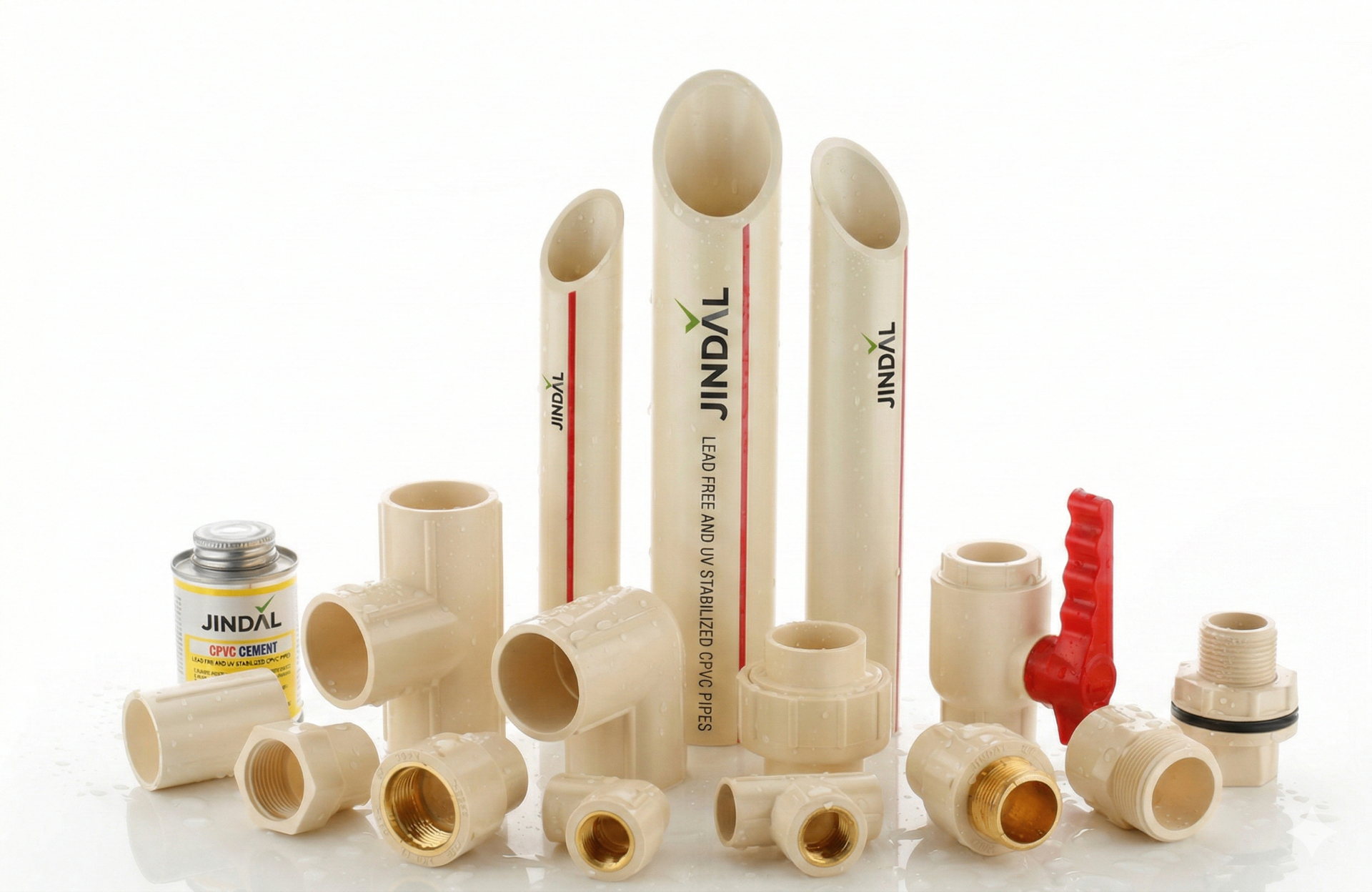
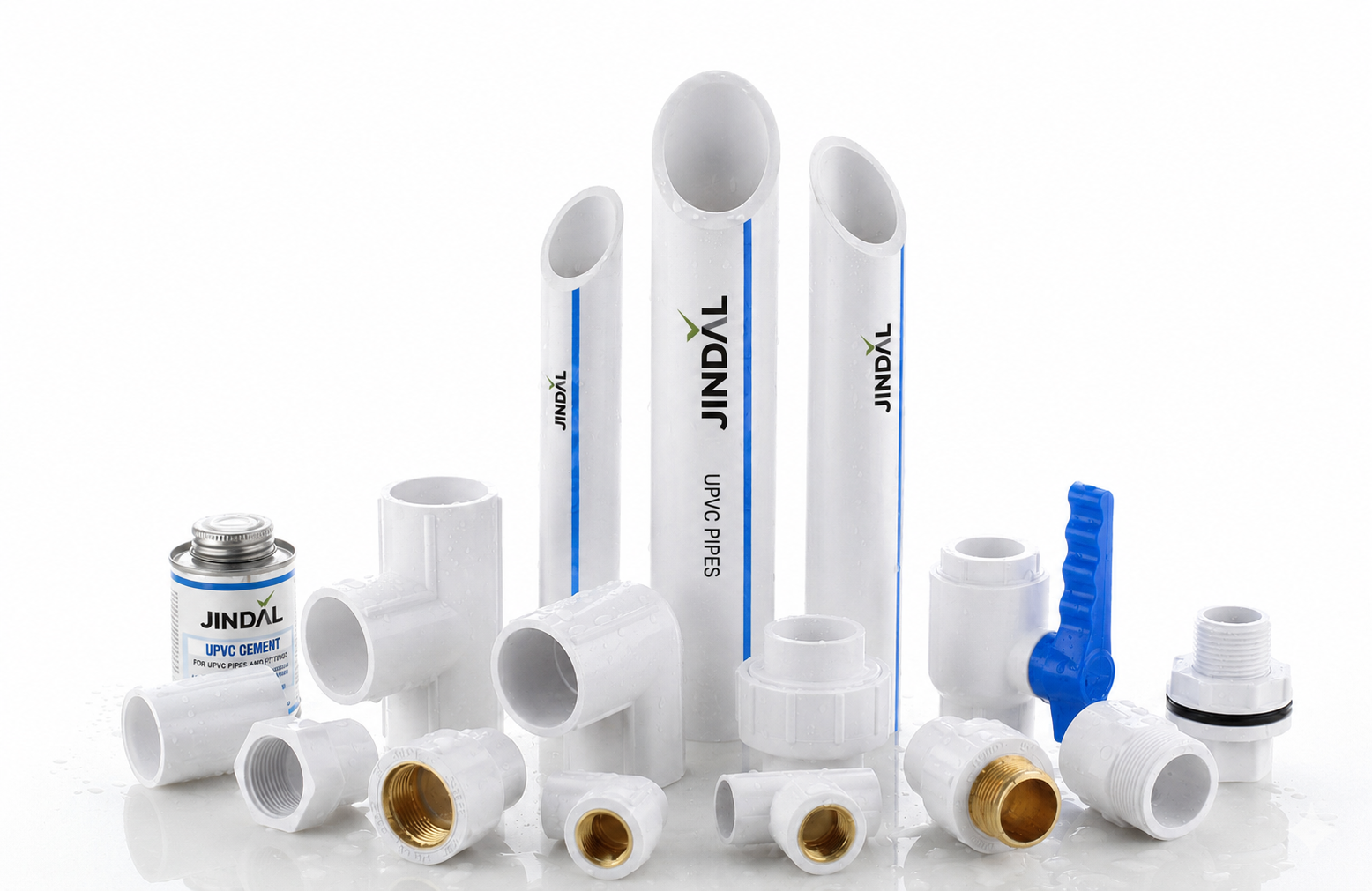
Jindal CPVC pipes and fittings are engineered for hot and cold water plumbing in residential, commercial and industrial buildings. Manufactured from a specially formulated Chlorinated Poly Vinyl Chloride (CPVC) compound, they combine the corrosion resistance of plastic with the strength and temperature tolerance needed for modern plumbing systems.
With a maximum service temperature of 93°C, the system is suitable for hot water lines from geysers, solar heaters and boilers, while remaining equally reliable for cold water distribution. The compound meets cell class DP 110-2-3-2 as per IS 15778 and is tested for dynamic thermal stability, fusion, torque and other rheological properties to ensure consistent extrusion quality and long-term mechanical performance.
The complete range covers Copper Tube Size (CTS) pipes from 15 mm (½") to 50 mm (2") in SDR 11 and SDR 13.5, and Iron Pipe Size (IPS) pipes from 65 mm (2½") to 300 mm (12") — backed by ISI certification and tested under IS 15778, IS 17546 and the relevant ASTM standards.
CTS pipes from 15 mm (½") to 50 mm (2") in SDR 11 (Class 1) and SDR 13.5 (Class 2) as per IS 15778. IPS pipes from 65 mm (2½") to 300 mm (12") as per ASTM F441. CPVC fittings are produced in SDR 11. CTS and IPS systems can be interconnected using IPS × CTS transition fittings. Compounds and finished pipes conform to ASTM D1784, ASTM D2846, ASTM F438, ASTM F439, ASTM F493, ASTM D2774, IS 15778 and IS 17546.
Thicker wall, higher pressure rating for the same diameter. Recommended for hot water risers and high-pressure runs.
Lighter wall option for cold water and low-pressure hot water branches in residential plumbing.
Jindal CPVC pipes and fittings are ISI-certified to IS 15778 and tested as per ASTM D1784, D2846, F441, F438, F439 and F493. The compound is a meticulously formulated indigenous CPVC blend of imported resin with impact modifiers, lubricants and UV stabilisers, ensuring excellent processability, impact strength and long-term hydrostatic performance. Pipes are non-toxic, safe for potable water and suitable for use with chlorinated municipal supply.
Long service life of 50+ years under normal plumbing conditions.
No corrosion, scaling or rust — preserves water purity over decades.
Solvent-cement joints are leak-proof and require no welding equipment.
Approximately 40% lower heat loss compared to metal pipes on hot water lines.
Lightweight — easy to handle, transport and install in concealed plumbing.
Low installation cost due to fast jointing and minimal site equipment.
Safe for drinking water — zero leaching of harmful chemicals.
Compatible with both CTS and IPS systems via transition fittings.
Cut the CPVC pipe square using a wheel cutter or fine-tooth saw and deburr both inside and outside edges.
Clean the pipe end and fitting socket with a dry cloth to remove dust, moisture and grease.
Apply a uniform coat of CPVC solvent cement to the outside of the pipe and a thin coat inside the fitting socket.
Insert the pipe fully into the fitting with a quarter-turn twist to spread the cement evenly.
Hold the joint firmly in place for 30 seconds and wipe off excess cement around the socket.
Allow the joint to cure as per cement manufacturer's instructions before pressure testing.
| Property | CPVC | PPR |
|---|---|---|
| Max. service temperature | 93°C | 70°C continuous |
| Jointing method | Solvent cement — cold weld | Heat fusion — requires welding machine |
| Site equipment | Hand tools, cement & primer only | Electric fusion welder, dies and power supply |
| Fire behaviour | Non-flammable, self-extinguishing | Combustible |
| Chlorine resistance | Unaffected by chlorinated potable water | Can degrade with high chlorine levels over time |
| Concealed plumbing | Preferred — small bend radius, rigid runs | Requires more support and space for fusion joints |
| Property | CPVC | GI / Steel | Copper | uPVC |
|---|---|---|---|---|
| Hot water capability | Up to 93°C | Yes (corrodes hot) | Yes | No (cold only) |
| Corrosion resistance | Excellent | Poor — rust & scale | Good | Excellent |
| Scale build-up | None | High | Moderate | None |
| Jointing | Solvent cement (cold) | Threading / welding | Brazing / soldering | Solvent cement |
| Weight | Light | Heavy | Medium | Light |
| Service life | 50+ years | 10 – 15 years | 30+ years | 30+ years |
| Drinking water safety | Safe — no leaching | Iron leaching over time | Safe | Safe |
| Installation cost | Low | High | Very high | Low |
| Pressure rating @ 23°C (½" SDR 11) | 27.9 bar | — | — | — |
All dimensions in mm. Working pressure shown at 23°C.
| Nominal Size | Mean OD | Min. Wall Thickness | Working Pressure (MPa) @ 23°C |
|---|---|---|---|
| 15 mm (½") | 15.90 | 1.73 | 2.79 |
| 20 mm (¾") | 22.20 | 2.03 | 2.79 |
| 25 mm (1") | 28.60 | 2.59 | 2.79 |
| 32 mm (1¼") | 34.90 | 3.18 | 2.79 |
| 40 mm (1½") | 41.30 | 3.76 | 2.79 |
| 50 mm (2") | 54.00 | 4.90 | 2.79 |
All dimensions in mm. Working pressure shown at 23°C.
| Nominal Size | Mean OD | Min. Wall Thickness | Working Pressure (MPa) @ 23°C |
|---|---|---|---|
| 15 mm (½") | 15.90 | 1.50 | 2.20 |
| 20 mm (¾") | 22.20 | 1.65 | 2.20 |
| 25 mm (1") | 28.60 | 2.11 | 2.20 |
| 32 mm (1¼") | 34.90 | 2.59 | 2.20 |
| 40 mm (1½") | 41.30 | 3.07 | 2.20 |
| 50 mm (2") | 54.00 | 4.01 | 2.20 |
Next Step
Talk to our team about sizing, pricing and project quantities — or grab the catalog and price list.