
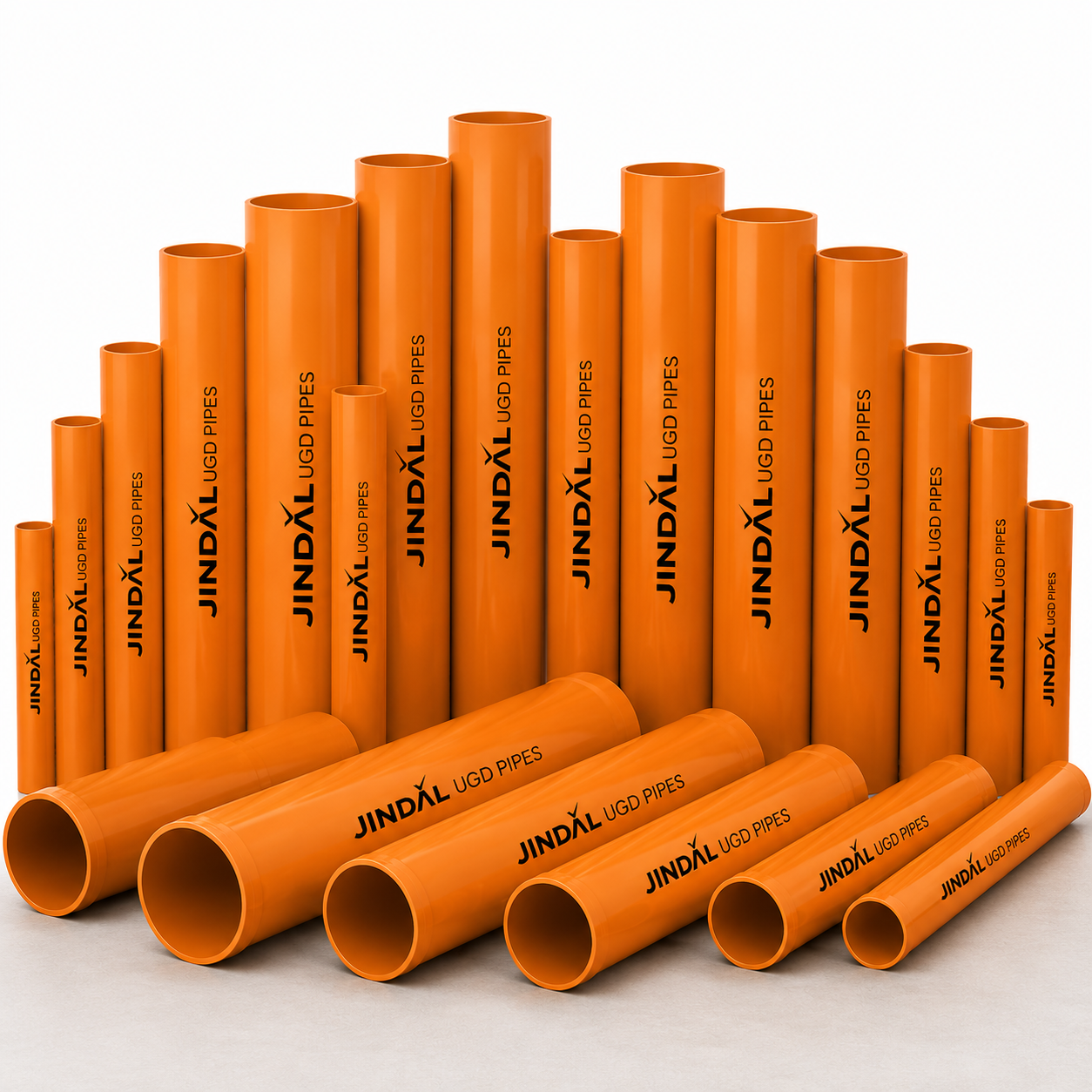
Cities ride on what they bury. Here's how PVC underground pipes carry sewage and storm-water for decades without leaks.
PVC underground pipes carry sewage, storm-water and industrial effluent under streets, townships and factories. They have replaced RCC and salt-glazed earthenware across Indian infrastructure projects because they are lighter, faster to lay, leak-proof at joints and don't corrode under sewer gas.
Indian Standards
IS 15328 — solid-wall PVC pipes for underground sewerage.
IS 16098 (Part 2) — structured-wall (DWC) pipes for non-pressure underground drainage.
Common Sizes
110 mm, 160 mm, 200 mm, 250 mm, 315 mm, 400 mm and 500 mm — covering household connections through to main municipal trunks.
Stiffness Classes (SN)
SN 4 and SN 8 are most common. SN 8 is used wherever traffic loading is expected over the pipe.
Installation Depth
Standard burial depth is 0.9–1.5 m to top of pipe under roads. Bed and surround with granular material (10–20 mm aggregate) for 150 mm above the crown before backfill.
Frequently Asked Questions
Which IS standard covers PVC underground sewerage pipes?
IS 15328 covers solid-wall PVC pipes and IS 16098 (Part 2) covers structured-wall DWC pipes for underground non-pressure sewerage and drainage.
What is SN 8 in PVC pipes?
SN 8 is a ring stiffness class indicating 8 kN/m² — used wherever the pipe is buried under roads or traffic loading.
How long do PVC underground pipes last?
Properly installed PVC underground sewer pipes have a design life of 100 years.
Reviewed by
Sahil Jindal
Managing Director, Jindal Composite Tubes Pvt Ltd
3rd-generation pipe manufacturer with 25+ years of hands-on experience in PVC, CPVC and UPVC pipe engineering, ISI/BIS compliance and India-wide plumbing distribution.