Pipes carry water — fittings decide where it goes. Here's how every common PVC fitting works and where to use it.
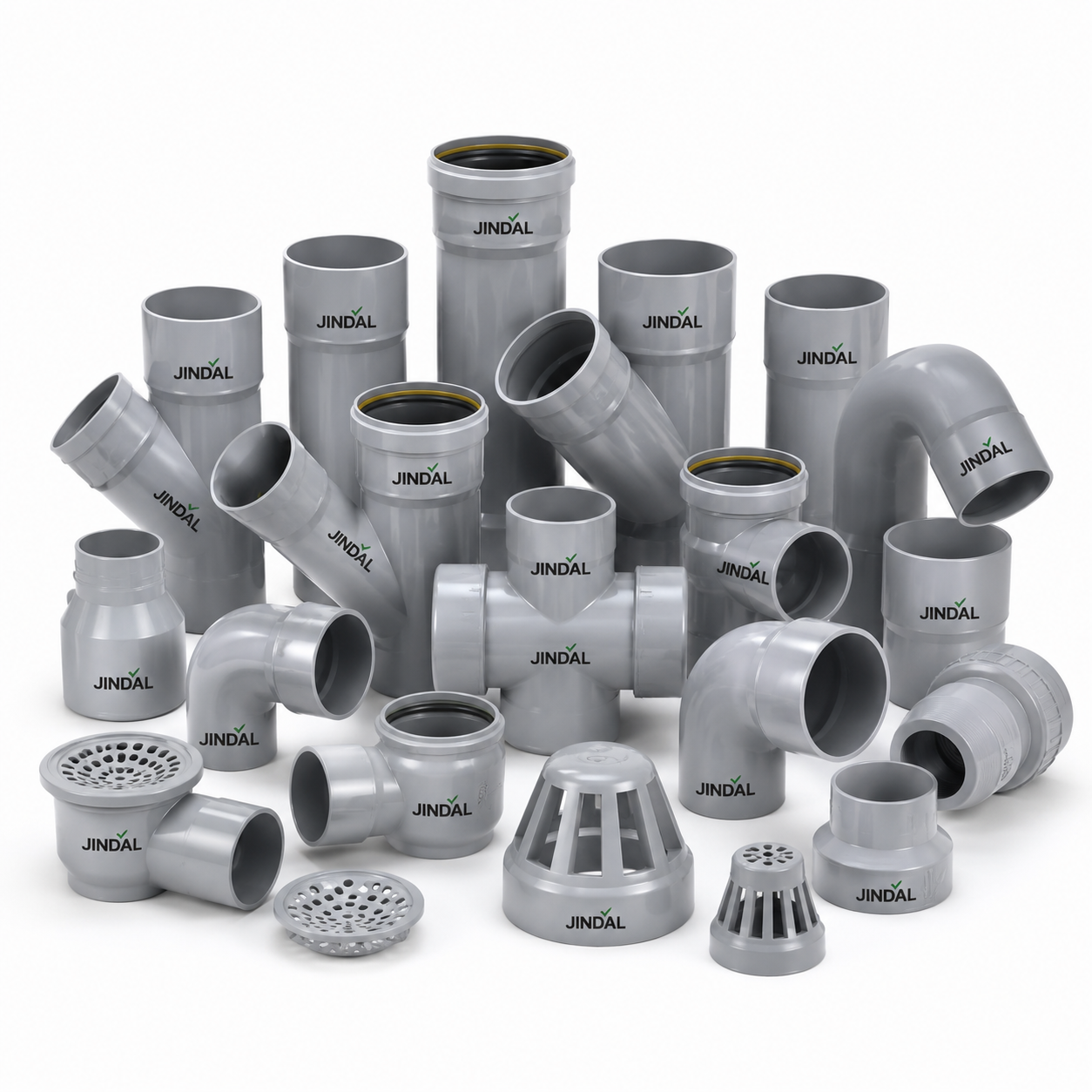
A plumbing system is only as good as its weakest joint. PVC fittings come in standardised shapes (IS 7834) that let you turn corners, branch lines, reduce sizes and connect to taps without a single leak — provided you specify and install them correctly.
Common PVC Fittings
Elbow (90° / 45°) — change direction.
Tee — split one line into two.
Coupler — join two pipes in a straight run.
Reducer — step a pipe down to a smaller diameter.
Union — removable joint for maintenance.
End cap — close off a line.
Threaded MTA / FTA — transition from PVC to metal taps and valves.
Solvent vs Threaded Joints
Solvent-weld joints (using PVC solvent cement) are permanent and the strongest. Threaded fittings are used only where the pipe meets a tap, valve or appliance that may need to be removed.
Avoiding Common Mistakes
Always deburr and dry the pipe end before solvent welding.
Apply solvent on both pipe and fitting socket.
Hold for 30 seconds; cure 24 hours before pressure test.
Never over-tighten threaded fittings — use Teflon tape, not excess force.
Frequently Asked Questions
Which standard applies to PVC fittings in India?
IS 7834 covers injection-moulded PVC fittings for pressure pipe systems in India.
Can I reuse PVC fittings?
No. Once solvent-welded, a PVC fitting is permanently bonded and cannot be reused.
Which solvent cement should I use?
Use only PVC solvent cement on PVC pipes and fittings — never CPVC cement. The two formulations are not interchangeable.
Reviewed by
Sahil Jindal
Managing Director, Jindal Composite Tubes Pvt Ltd
3rd-generation pipe manufacturer with 25+ years of hands-on experience in PVC, CPVC and UPVC pipe engineering, ISI/BIS compliance and India-wide plumbing distribution.