
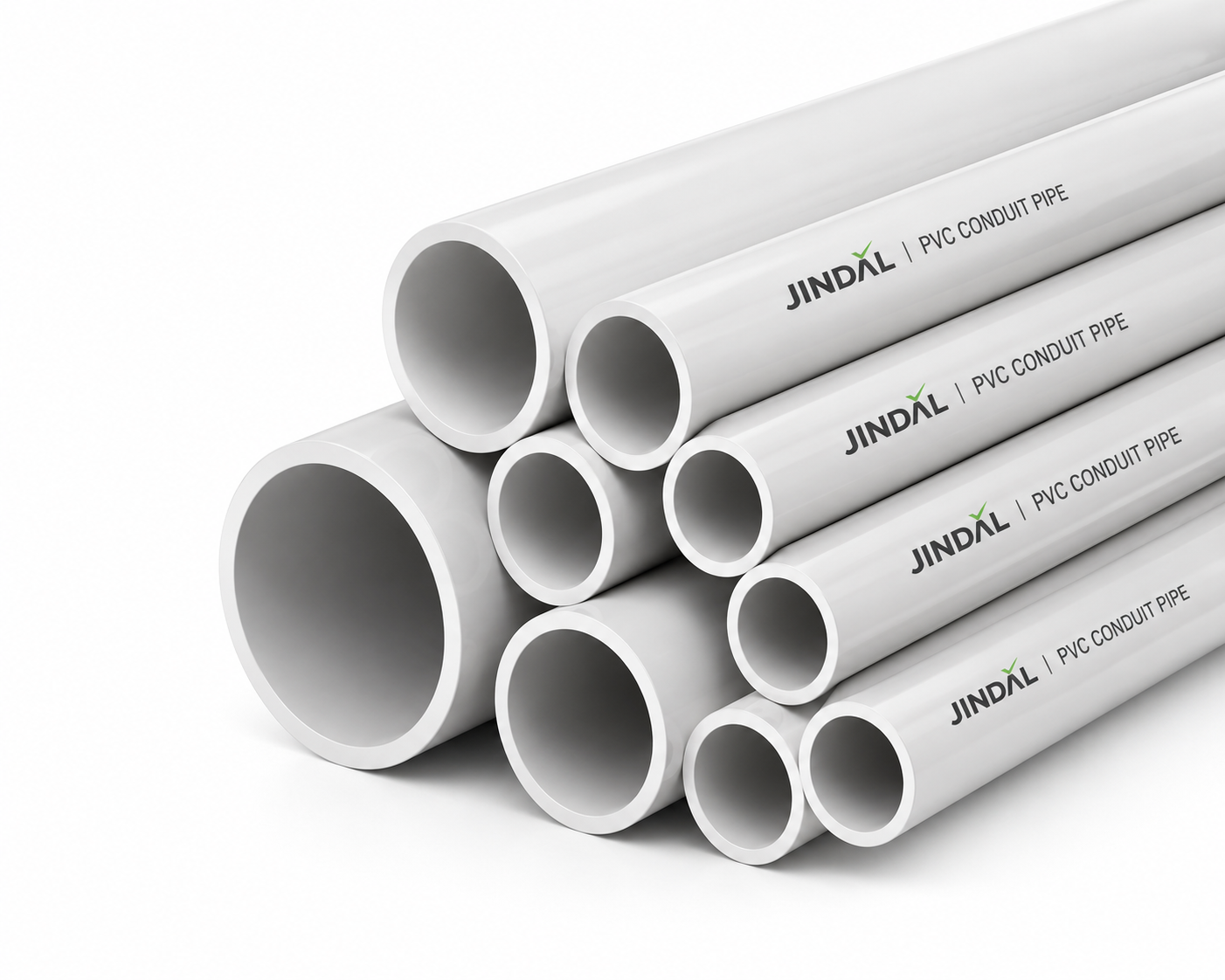
The pipe inside your wall protects your wiring — and your home. Here's why PVC conduit is the modern standard.
Every modern Indian building uses PVC electric conduit pipes for concealed wiring. They protect cables mechanically, are flame-retardant, and let you re-pull wires decades later without breaking walls.
Indian Standard: IS 9537
IS 9537 (Parts 1 and 3) covers rigid plain PVC conduits for electrical installations, defining wall thickness, impact resistance, flame retardancy and compression strength.
Common Sizes
19 mm, 20 mm, 25 mm, 32 mm and 40 mm — chosen based on cable count and cable size per the IS 732 wiring code.
Why PVC Conduit Over Bare Cable
Flame retardant — self-extinguishing if cable shorts.
Mechanical protection from nails, drills and rodent damage.
Allows future re-wiring without breaking plaster.
Insulating shell — additional shock safety.
Heavy vs Medium Mechanical
Heavy mechanical (HM) conduit has thicker walls for industrial and outdoor use. Medium mechanical (MM) is standard for indoor concealed wiring.
Frequently Asked Questions
Which IS standard covers PVC electric conduit?
IS 9537 (Parts 1 and 3) covers rigid PVC conduits for electrical installations in India.
Is PVC conduit flame-retardant?
Yes. PVC conduit to IS 9537 is self-extinguishing and tested for glow-wire ignition.
What size conduit do I need?
Match conduit size to cable bundle per IS 732. As a rule of thumb: 20 mm for 2–3 wires, 25 mm for 4–5 wires, 32 mm for sub-mains.
Reviewed by
Sahil Jindal
Managing Director, Jindal Composite Tubes Pvt Ltd
3rd-generation pipe manufacturer with 25+ years of hands-on experience in PVC, CPVC and UPVC pipe engineering, ISI/BIS compliance and India-wide plumbing distribution.