
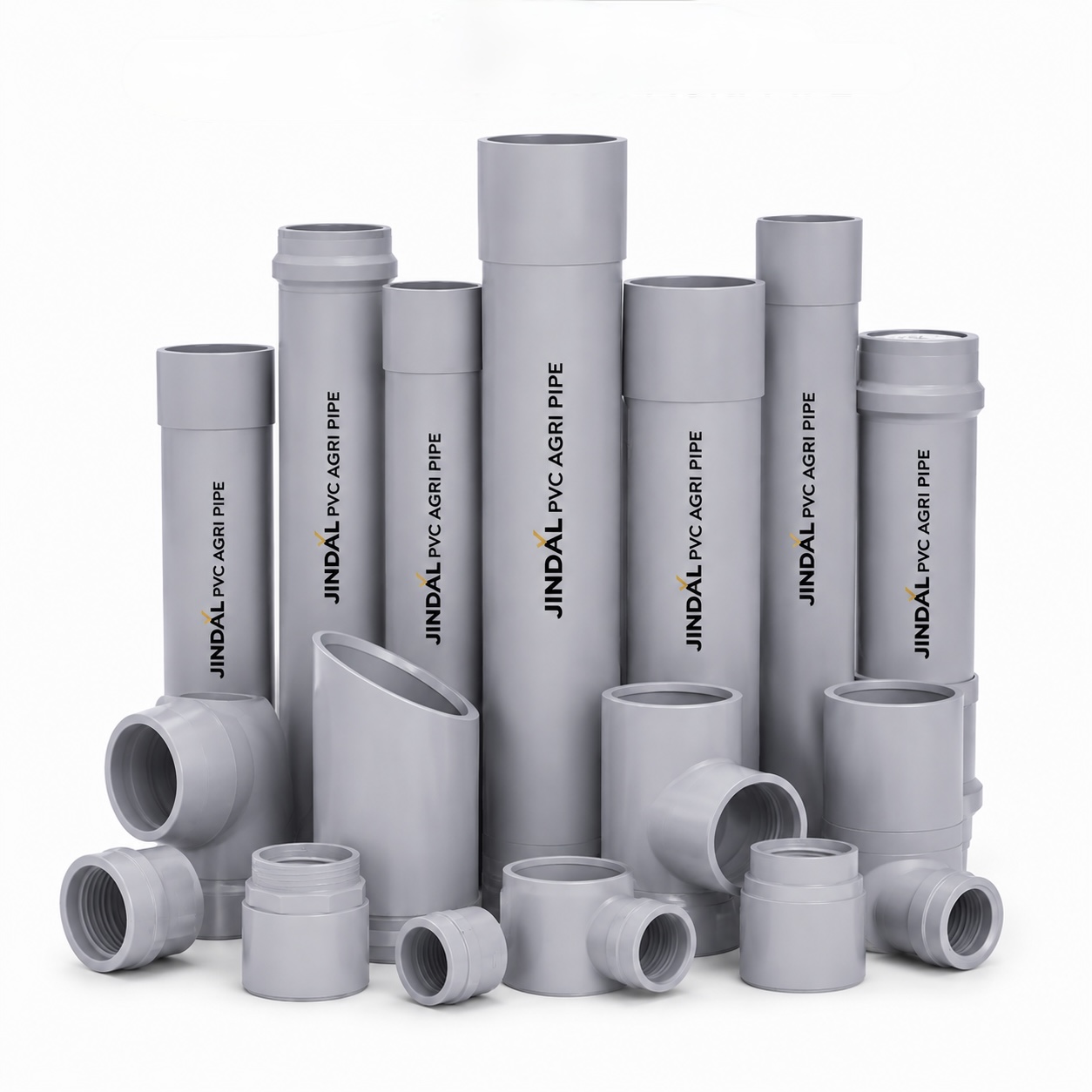
From sprinklers to lift irrigation, PVC agriculture pipes deliver water efficiently across Indian farms. Here's how to size and specify them correctly.
PVC agriculture pipes have become the default choice for irrigation across India — replacing GI and HDPE for most surface and sub-surface farm water systems. They are light, corrosion-proof, easy to join with solvent cement, and certified to IS 4985.
Applications on the Farm
Main and sub-main irrigation lines from canals, ponds and tube-wells.
Sprinkler systems and movable risers.
Lift irrigation from rivers and reservoirs.
Drip irrigation backbone and field distribution.
Pressure Classes Under IS 4985
Class 1 — 2.5 kgf/cm² for low-pressure gravity feeds.
Class 2 — 4 kgf/cm² for typical farm distribution.
Class 3 — 6 kgf/cm² for sprinkler mains and longer runs.
Class 4 / 5 / 6 — 8–12.5 kgf/cm² for pumped or elevated systems.
How to Choose the Right Size
Sprinkler sub-mains: 63 mm or 75 mm.
Main feeders from pump to field: 90 mm to 140 mm depending on flow.
Lift irrigation rising mains: 110 mm to 200 mm.
Why ISI Marked Matters
Cheap unbranded pipes often use reprocessed scrap, run under-thickness and crack within a single summer. Always insist on the ISI mark and the IS 4985 print every metre.
Frequently Asked Questions
Which PVC pipe is best for irrigation?
ISI-marked PVC pipes to IS 4985, Class 2 or Class 3, are the standard choice for most Indian farm irrigation systems.
What is the life of PVC agriculture pipes?
Quality ISI-marked PVC agri pipes used within their pressure rating last 25 to 50 years even under field conditions.
Can PVC agriculture pipes be buried?
Yes. Burying actually extends pipe life by protecting it from UV and mechanical damage.
Reviewed by
Sahil Jindal
Managing Director, Jindal Composite Tubes Pvt Ltd
3rd-generation pipe manufacturer with 25+ years of hands-on experience in PVC, CPVC and UPVC pipe engineering, ISI/BIS compliance and India-wide plumbing distribution.