
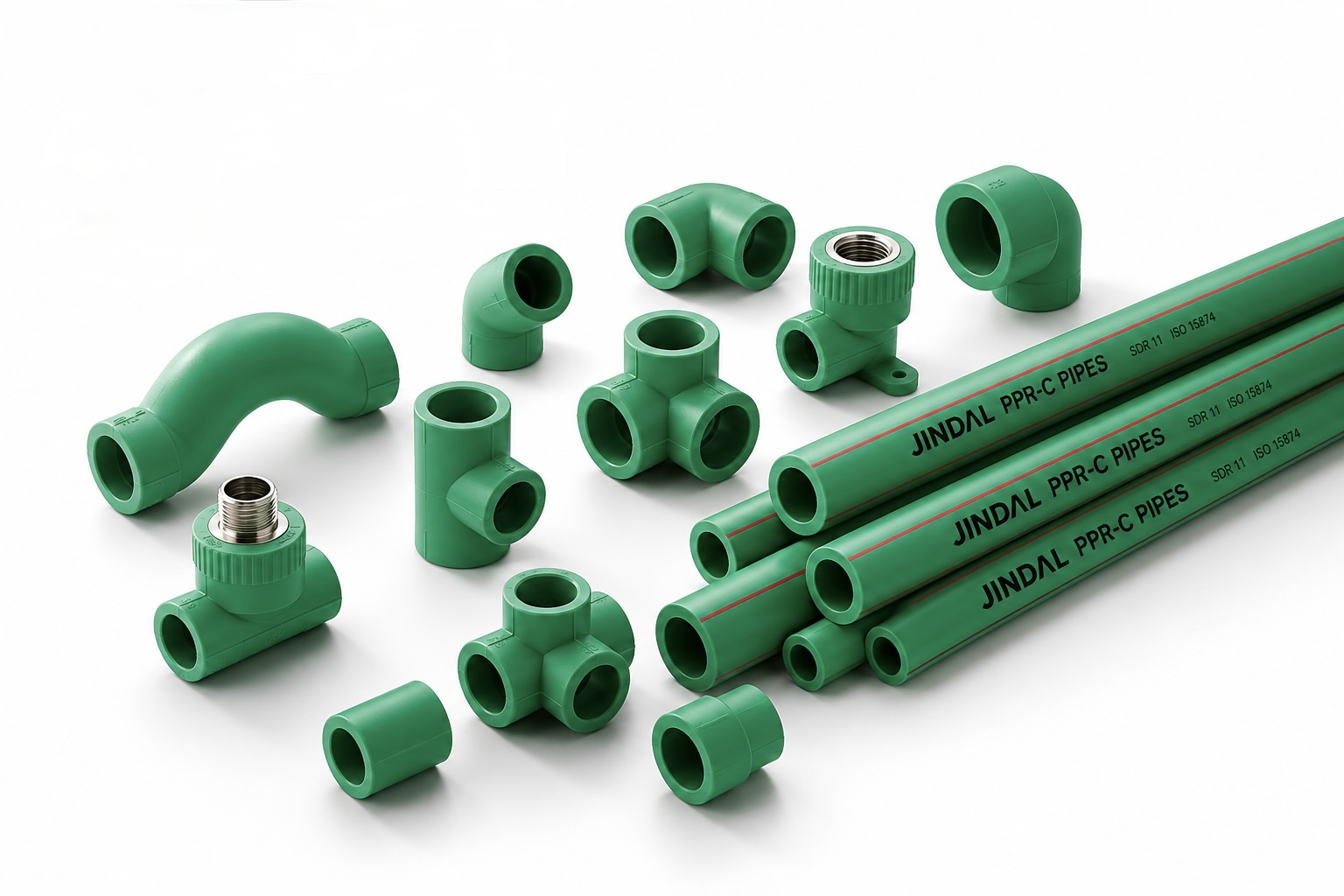
PPR pipes fuse into a single homogeneous joint — stronger than the pipe itself. Here's everything you need to weld them right.
PPR (Polypropylene Random Copolymer) pipes have become the go-to system for premium residential, hospitality and industrial plumbing. The defining feature: socket-fusion welding melts pipe and fitting into a single piece, eliminating the joint as a failure point.
Why PPR
Service life 50+ years on hot and cold water.
Chemically inert — safe for potable water and aggressive industrial fluids.
Low thermal conductivity — energy-efficient hot water runs.
Fusion joints are leak-proof for the life of the system.
Fusion Welding Quick Reference
Welder temperature: 260 ± 10°C.
20 mm pipe — heat 5 s, weld 4 s, cool 2 min.
25 mm — heat 7 s, weld 4 s, cool 2 min.
32 mm — heat 8 s, weld 6 s, cool 4 min.
Always insert square, never twist during weld.
PPR vs CPVC
Joining: PPR fuses, CPVC uses solvent cement. Fusion is stronger; solvent is faster.
Cost: PPR is typically 20–30% more expensive than CPVC.
Temperature: Both rated to 93°C; PPR is slightly more chemical-resistant.
Frequently Asked Questions
Is PPR better than CPVC?
Both are excellent for hot and cold plumbing. PPR has the edge on joint strength and chemical resistance; CPVC wins on installation speed and price.
What temperature for PPR fusion welding?
260 ± 10°C is the standard fusion temperature for PPR socket welding.
How long do PPR pipes last?
Quality PPR pipes installed correctly have a design service life of 50+ years on hot and cold water.
Reviewed by
Sahil Jindal
Managing Director, Jindal Composite Tubes Pvt Ltd
3rd-generation pipe manufacturer with 25+ years of hands-on experience in PVC, CPVC and UPVC pipe engineering, ISI/BIS compliance and India-wide plumbing distribution.