
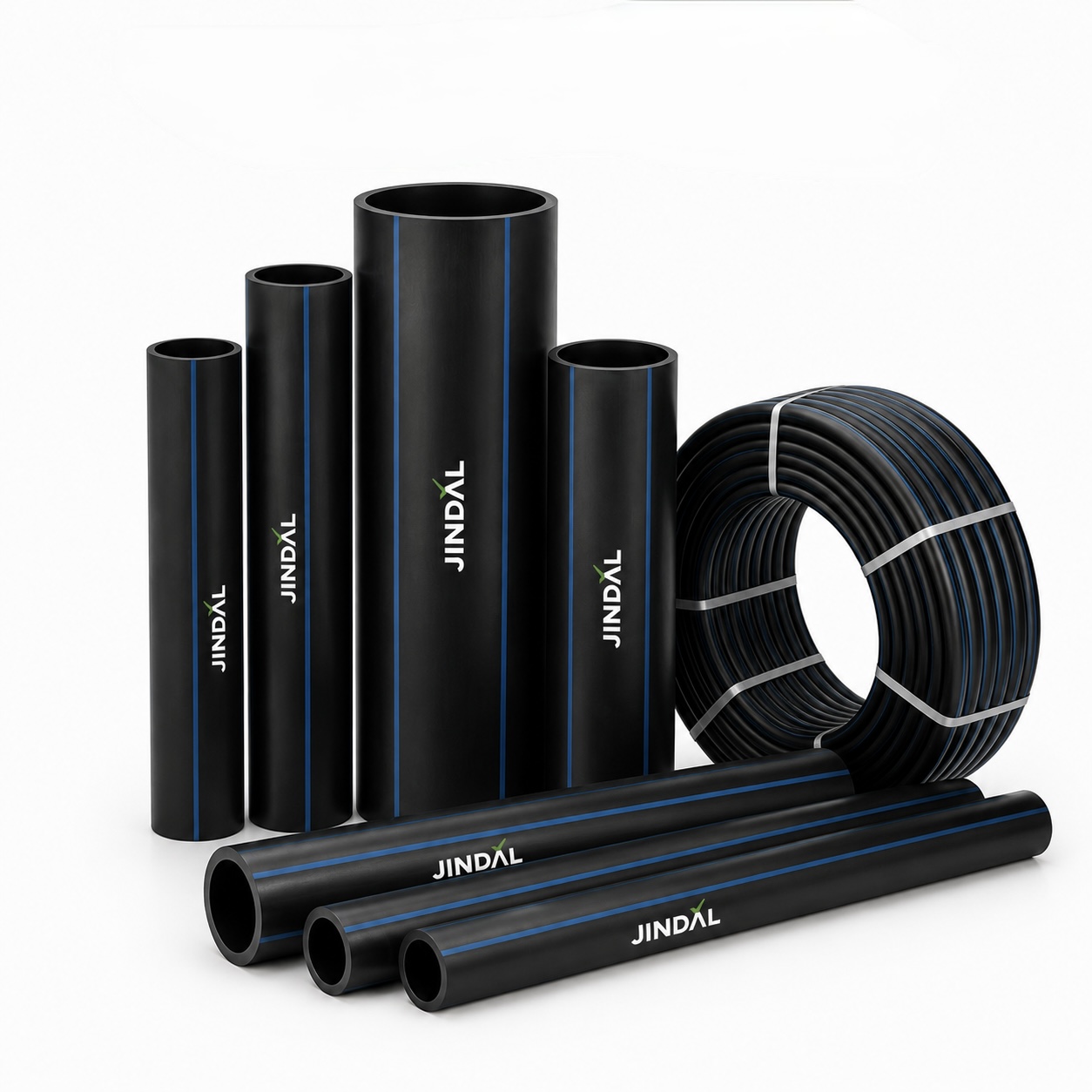
PVC is cheaper on day one. HDPE almost always wins by year seven. Here is the full 10-year cost math for an Indian farm so you buy the pipe that actually costs less.
Every farmer facing a new irrigation layout asks the same question: HDPE or PVC. The counter answer is usually PVC because it is cheaper per metre. The 10-year answer is often different, and this article walks through the actual math so you can pick with numbers rather than shelf price.
Upfront Price Comparison — 90mm Main Line
For a like-for-like 90mm main irrigation line at 6 kgf/cm2 working pressure, indicative Q1 2026 rates are:
| Parameter | PVC (IS 4985 Class 3) | HDPE (IS 4984 PE80 PN6) |
|---|---|---|
| Pipe material cost | INR 12,500 | INR 17,800 |
| Joining / fittings | INR 900 | INR 1,600 |
| Trenching + laying | INR 3,000 | INR 3,000 |
| Total installed cost | INR 16,400 | INR 22,400 |
The Lifespan Difference
Both pipes are ISI marked and pressure rated for 50 years in theory. In real farm conditions, actual life diverges sharply:
PVC in agricultural service: 15 to 25 years. Fails from UV exposure on above-ground sections, cattle strike, tractor damage and brittle-crack at solvent joints in cold weather.
HDPE in agricultural service: 25 to 40 years. Flexible walls absorb impact, UV-stable resin resists degradation, and joints are fusion-welded so they are stronger than the pipe body.
The Ten Year Total Cost Math
The table below assumes 100 metres of 90mm main, above-ground layout on a working farm, with realistic damage and maintenance events.
| Cost Component | PVC Class 3 | HDPE PN6 |
|---|---|---|
| Year 0 install | INR 16,400 | INR 22,400 |
| Year 2 UV / crack repairs (5 joints) | INR 2,100 | INR 0 |
| Year 4 tractor strike replacement (10 m) | INR 1,850 | INR 300 (weld repair) |
| Year 6 winter brittle crack (3 sections) | INR 2,400 | INR 0 |
| Year 8 solvent joint reworks | INR 1,900 | INR 0 |
| Year 10 partial re-laying | INR 8,000 | INR 0 |
| Total 10 year cost | INR 32,650 | INR 22,700 |
| Downtime days over 10 years | 18 to 25 days | 0 to 3 days |
When PVC Still Wins
PVC is still the right choice for:
Fully buried mains where UV and impact are eliminated.
Short-term seasonal layouts you plan to lift and replace every 3 to 5 years.
Small hobby farms where downtime is not commercially critical.
Sprinkler risers where you want rigid uprights rather than flexible pipe.
When HDPE is the Clear Winner
Long above-ground mains crossing fields and tracks.
Sub-surface drip backbone that must stay leak-free for a decade.
Lift-irrigation rising mains where joint reliability is non-negotiable.
Any layout where a burst mid-season loses a crop cycle.
Practical Recommendation
For a modern Indian farm with a mix of drip, sprinkler and flood irrigation, our engineers recommend HDPE for the primary mains and rising mains, PVC pressure pipes for buried sub-mains, and PVC agriculture pipes to IS 4985 for movable sprinkler risers. This mix minimises upfront cost while keeping the failure-critical sections on HDPE.
Frequently Asked Questions
Is HDPE really cheaper than PVC over 10 years?
For above-ground and semi-exposed mains on a working farm, yes. HDPE saves roughly 30 percent over 10 years once you count repairs, downtime and partial relays. For fully buried short-run mains, PVC often stays cheaper.
How is HDPE pipe joined?
By heat fusion — either butt fusion for larger diameters or electrofusion for repairs and fittings. Fusion joints are stronger than the pipe body itself.
Can I mix HDPE and PVC in the same irrigation system?
Yes. Use HDPE for main above-ground runs and PVC for buried sub-mains and sprinkler risers. Transition with a threaded or flanged adaptor.
Which is better for drip irrigation, HDPE or PVC?
HDPE is better for the buried backbone because of long-term joint reliability. PVC is fine for the branch lines that feed the drip laterals.
Reviewed by
Sahil Jindal
Managing Director, Jindal Composite Tubes Pvt Ltd
3rd-generation pipe manufacturer with 25+ years of hands-on experience in PVC, CPVC and UPVC pipe engineering, ISI/BIS compliance and India-wide plumbing distribution.