
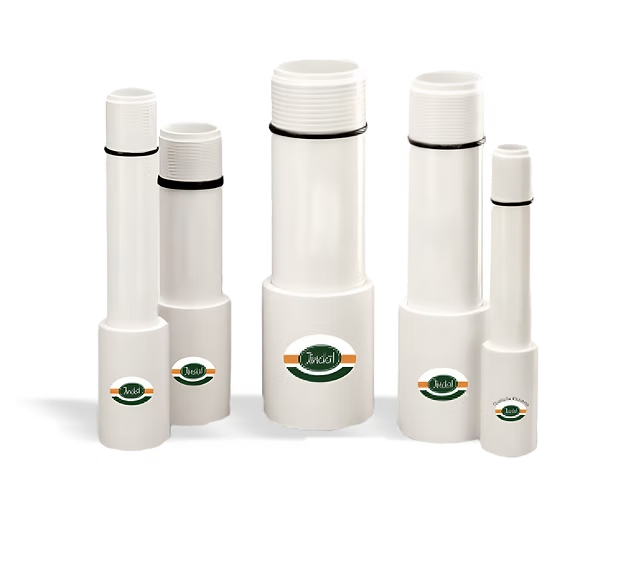
A dropped submersible pump is a five-figure recovery job. Choosing the right column pipe class, thread and reinforcement upfront prevents it. Here is how our engineers spec every borewell.
A borewell pump dangling 200 feet below ground is only as reliable as the column of pipe holding it there. Get the column pipe class wrong and a joint fails silently, the pump drops, and you are looking at a five to seven day recovery operation costing far more than the pipe itself.
This guide walks through the three decisions that matter — depth class, pump load matching and thread type — using the IS 12818 framework our design team uses every day.
Why Column Pipes Are Different from Regular Pressure PVC
A column pipe carries the vertical load of the pump plus the weight of the water column plus the pump reaction thrust. Regular PVC pressure pipe is not designed for this axial load and has a slip-fit socket that will pull apart under a heavy pump.
Column pipes to IS 12818 use an integral square-cut trapezoidal thread with a rubber O-ring seal — designed specifically to hold axial pump weight and water thrust without loosening.
The Depth and Load Selection Chart
Use the chart below to match column pipe class to well depth and pump horsepower. This is the same chart our channel partners use at the counter.
| Well Depth | Pump HP | Column Pipe Class | Wall Type | Typical Size |
|---|---|---|---|---|
| Up to 150 ft | 0.5 to 1 HP | Class I (Low) | Standard | 1 inch to 1-1/4 inch |
| 150 to 300 ft | 1 to 2 HP | Class II (Medium) | Ribbed | 1-1/4 to 1-1/2 inch |
| 300 to 500 ft | 2 to 3 HP | Class III (High) | Ribbed / Reinforced | 1-1/2 to 2 inch |
| 500 to 800 ft | 3 to 5 HP | Class IV (Extra High) | Ribbed + Reinforced | 2 to 2-1/2 inch |
| 800 ft + | 5 HP + | Class V (Very High) | Reinforced heavy wall | 2-1/2 to 3 inch |
Understanding the Thread System
IS 12818 specifies a trapezoidal square-cut thread with a rubber O-ring. When installed correctly, the thread transfers axial load and the O-ring seals the water. Do not use tape, sealant paste or thread lock on this joint — the O-ring is the only sealing element and additives interfere with it.
Always couple with the same brand's coupler. Cross-brand threads have small geometric variations that reduce load capacity by 20 to 30 percent.
Ribbed vs Plain Wall
Ribbed column pipes have external longitudinal ribs that stiffen the pipe against pump vibration and slightly reduce clamp-marking. Ribs also help with grip during installation. For any well over 200 feet or any pump above 1 HP, specify ribbed.
Installation Rules That Prevent Pump Drops
1. Torque the coupler by hand + one turn with a pipe wrench. Overtightening cracks the socket.
2. Every joint gets a new O-ring — never reuse.
3. Support the string at every 3 metre length with a clamp on the well head as you lower.
4. Install a safety rope of stainless wire rope in parallel — even the best column pipe deserves a backup.
5. Do not exceed the class depth limit even if the well is deeper. Move up one class.
Common Failure Modes and How to Avoid Them
Joint pull-out: caused by under-classed pipe or cross-brand couplers. Fix by matching class to load and staying in one brand.
Vibration crack at socket: caused by loose clamping. Support the string properly and use ribbed pipe.
O-ring leak: caused by reused rings or thread paste. Always use new rings and clean threads.
UV degradation of above-ground portion: caused by leaving pipe exposed at the well head. Sleeve the exposed portion or paint UV-stable coating.
Frequently Asked Questions
Which column pipe is best for a 300 foot borewell?
For a 300 foot borewell with a 2 to 3 HP pump, use Class III ribbed column pipe to IS 12818 in 1-1/2 to 2 inch diameter.
Can I use regular PVC pipe as column pipe?
No. Regular PVC pressure pipe uses solvent-cement slip sockets that cannot carry the axial pump load. Always use IS 12818 column pipes with threaded couplers.
How is a column pipe joint sealed?
By a rubber O-ring seated in the coupler socket. Never use tape, thread paste or sealant — they interfere with the O-ring seal.
How do I know what class column pipe I need?
Match the pipe class to well depth and pump HP using the IS 12818 selection chart, or share your borewell depth and pump HP with our team on WhatsApp and we will recommend the class.
Reviewed by
Sahil Jindal
Managing Director, Jindal Composite Tubes Pvt Ltd
3rd-generation pipe manufacturer with 25+ years of hands-on experience in PVC, CPVC and UPVC pipe engineering, ISI/BIS compliance and India-wide plumbing distribution.