
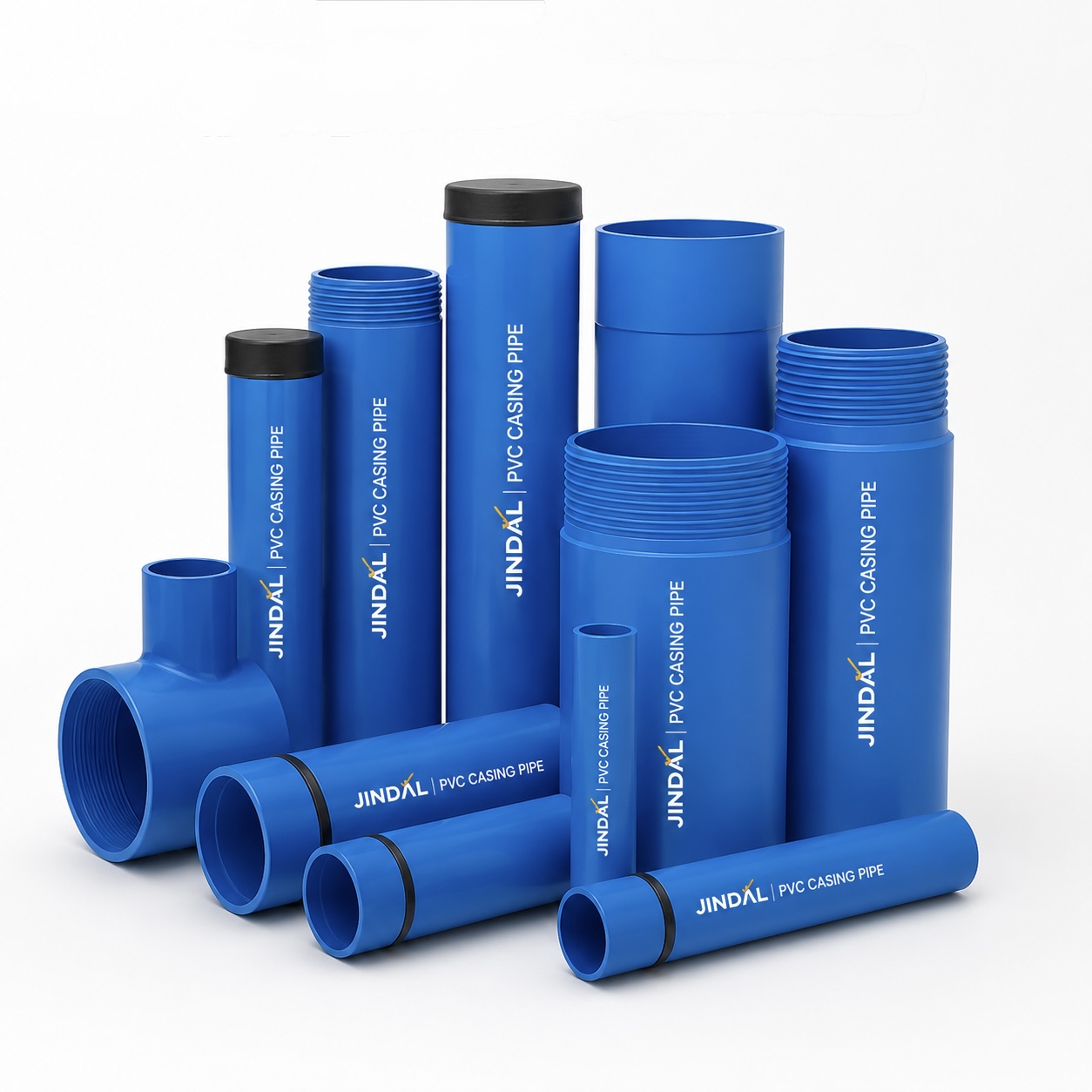
Casing pipe holds the borewell open for its entire service life. Shallow, medium and deep wells need different casing classes. Here is the selection chart our engineers use every day.
The casing pipe is what keeps a borewell open. It stops the surrounding formation from collapsing into the bore, keeps surface contaminants out of the aquifer, and provides a stable annular space around the submersible pump. Casing failure means well collapse, and well collapse means a new borewell — costs of INR 1 to 3 lakh gone in a day.
This guide walks through the three casing decisions that matter for any Indian borewell: depth class, thread system and wall thickness, using the IS 12818 framework.
Casing vs Column Pipe — Not the Same Thing
Column pipe carries the pump inside the bore and handles axial load from the pump weight and water thrust.
Casing pipe lines the bore itself, keeps the hole open and protects the aquifer.
Both are covered by IS 12818 but have different classes, thread systems and wall requirements. Never substitute one for the other.
Selection Chart by Well Depth
Shallow, medium and deep well casing classes are defined by well depth and the collapse load the pipe must resist.
| Well Type | Depth Range | Casing Class | Typical Wall | Typical OD |
|---|---|---|---|---|
| Shallow well | Up to 80 m | CS (Casing Shallow) | 3.5 to 4.5 mm | 110 to 140 mm |
| Medium well | 80 to 200 m | CM (Casing Medium) | 5.0 to 6.5 mm | 140 to 165 mm |
| Deep well | 200 to 400 m | CD (Casing Deep) | 7.0 to 9.5 mm | 165 to 200 mm |
| Very deep well | 400 m + | CD reinforced | 9.5 mm + | 200 mm + |
The Thread System
IS 12818 casing pipes use a threaded coupling with a rubber ring seal — similar in principle to the column pipe thread but sized for the larger casing OD. The thread carries the tensile load of the entire casing string hanging in the bore, and the O-ring keeps the surrounding formation water and cement grout out of the pump space.
Do not use tape, thread paste or lock compounds on casing threads — the O-ring is the only intended seal.
Plain vs Slotted vs Ribbed Casing
Plain casing: sealed pipe for the upper section of the bore where you do not want water entry.
Slotted (screen) casing: pipe with machined horizontal slots that allow aquifer water to enter the bore in the productive zone. Slot width matches the surrounding formation — usually 0.5 to 3 mm.
Ribbed casing: external longitudinal ribs stiffen the pipe against collapse pressure and vibration. Recommended for medium and deep wells and for any well drilled through loose or sandy formations.
A typical deep well casing string is plain at the top, slotted through the aquifer zone and plain again below the aquifer if needed.
Installation Practice
1. Lower each casing joint slowly, using a clamp on the well head to support the string.
2. Every joint gets a new O-ring — never reuse.
3. Cement grout the annular space between casing and formation at the top 3 to 6 metres to seal surface water out of the aquifer.
4. Cap the well head with a lockable casing cap between the drill completion and pump installation to keep debris and small animals out.
5. Keep a written casing log with joint counts, depth marks and screen slot positions — invaluable for future service.
Common Failure Modes
Casing collapse: caused by under-classed pipe or slotted section placed in an unstable formation. Always match class to depth and consult the geologist for slot placement.
Thread pull-apart: caused by cross-brand couplers or overtightened joints cracking the socket. Use same-brand couplers and hand-tighten plus one turn.
O-ring cut on installation: caused by burred thread edges or misalignment. Inspect every ring before it goes down.
Vertical shift under grout pressure: caused by inadequate wellhead support during grout injection. Support the string properly.
Where Jindal Casing Pipes Fit
Jindal PVC casing pipes are manufactured to IS 12818 in CS, CM and CD classes, in plain, slotted and ribbed profiles. Standard diameters range from 110 mm to 200 mm with wall thickness matched to the depth class. All variants use ISI-marked couplers with the specified O-ring system.
Frequently Asked Questions
What is the difference between casing and column pipe?
Casing pipe lines the borewell to keep the hole open and protect the aquifer. Column pipe carries the submersible pump inside the bore and handles the pump axial load. Both are covered by IS 12818 but with different classes and threads.
Which casing pipe should I use for a 250 m deep borewell?
For a 250 m deep borewell use Class CD (Casing Deep) with 7 to 9.5 mm wall thickness, in ribbed profile for the productive zone, sized 165 to 200 mm OD depending on pump size.
What is slotted casing pipe used for?
Slotted (screen) casing is placed in the productive aquifer zone. Machined slots let groundwater enter the bore while keeping formation sand out. Slot width is matched to the surrounding formation grain size.
Are Jindal casing pipes ISI marked?
Yes. Every Jindal PVC casing pipe is manufactured to IS 12818 under valid BIS licence and carries the ISI mark with class, size and batch printed every metre.
Reviewed by
Sahil Jindal
Managing Director, Jindal Composite Tubes Pvt Ltd
3rd-generation pipe manufacturer with 25+ years of hands-on experience in PVC, CPVC and UPVC pipe engineering, ISI/BIS compliance and India-wide plumbing distribution.